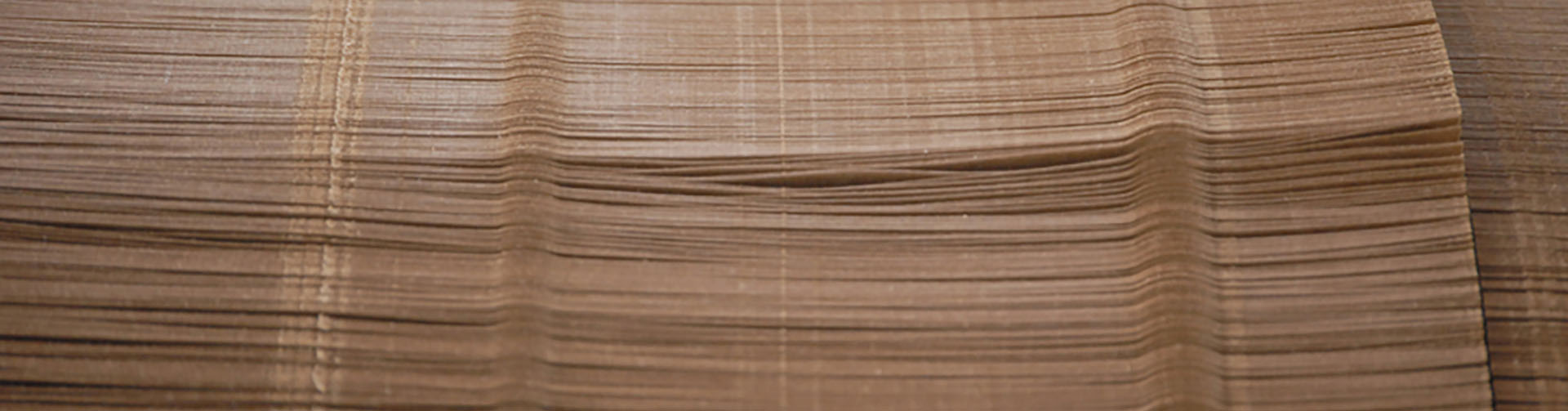
These papers are used to protect and package products. They are mainly formed into boxes or bags, but comprise a wide of array of both light and heavy packaging. They can be produced with recycled fiber, and mechanical resistance is one of their basic characteristics.
These papers are used as packaging for broad array of products ranging from medicines to foodstuffs including drinks and frozen foods. They can also be used for other purposes, like lining walls or envelopes.
Impermeability and other characteristics required for direct contact with food and other products are defined by how the paper is manufactured and how it is combined with other materials like plastics and metals.
Fluting paper
Packaging paper used to make sheets and boxes.
Kraftliner (1st grade liner)
Paper with a high proportion of virgin fibers that meets the strength specifications needed for the cover or lining of corrugated cardboard boxes.
Testliner (2nd grade liner)
Paper similar to kraftliner, but with inferior properties due to the high proportion of recycled raw materials it contains.
White top liner
White paper made with a large proportion of virgin fibers that meets the strength specifications required for use in corrugated cardboard boxes.
Duplex paperboard
Made up of two layers with different colors or compositions. In addition to rigidity for packaging and boxes, it has high surface strength, uniform thickness, and water and ink absorption that permits offset printing.
Triplex paperboard
Containing three or more layers, with characteristics similar to duplex paperboard. This board is used in packaging for chocolates, cosmetics, medicines, fast food and drinks.
Solid cardboard
Contains different white layers and is used in packaging for cosmetics, medications, personal care products, book covers and postcards.
Molded pulp
This product is obtained by breaking up or separating fibers from waste paper, mainly newspaper. The fibers are mixed with water and chemicals to form a paste that is used to make products such as trays for transporting and protecting products like fruit and vegetables, eggs, light bulbs, cell phones, refrigerators and stoves.
Natural kraft for multi-ply bags
Paper made essentially from long fibers. Highly resistant to tearing with good bursting strength, mainly used for large industrial bags and packaging.
Extensible kraft
Made mainly from long-fiber pulp, highly resistant to tearing and stretching; it is used to package paper bags.
Natural, white or colored kraft for other purposes
Made essentially from long fibers, this paper can be glossy or smooth, with similar characteristics to natural kraft paper used for multi-ply bags. It is used to make small bags, sacks and packaging in general.
Prime grade kraft and second grade kraft
Packaging paper that is similar to natural or colored kraft but less strong; may be glossy, generally used for bags, etc.
Recycled/recovered paper for freight packing
Greyish naturally-colored paper made mainly from scraps. Used for product wrapping that does not require printing, as well as tubes and cones.
Tissue paper
White or colored packaging paper used for light packaging, wrapping artworks, interleaving, decorations, protecting fruit, etc.
Glassine, crystal or parchment paper
The main characteristic of this paper is its transparency, which is achieved through a high degree of refinement in the production process. It is used in food packaging, to protect fruit on trees and self-adhesive paper.
Greaseproof paper
This translucent paper is highly impermeable to oils and is used to package greasy products.